Aka Washington Mills
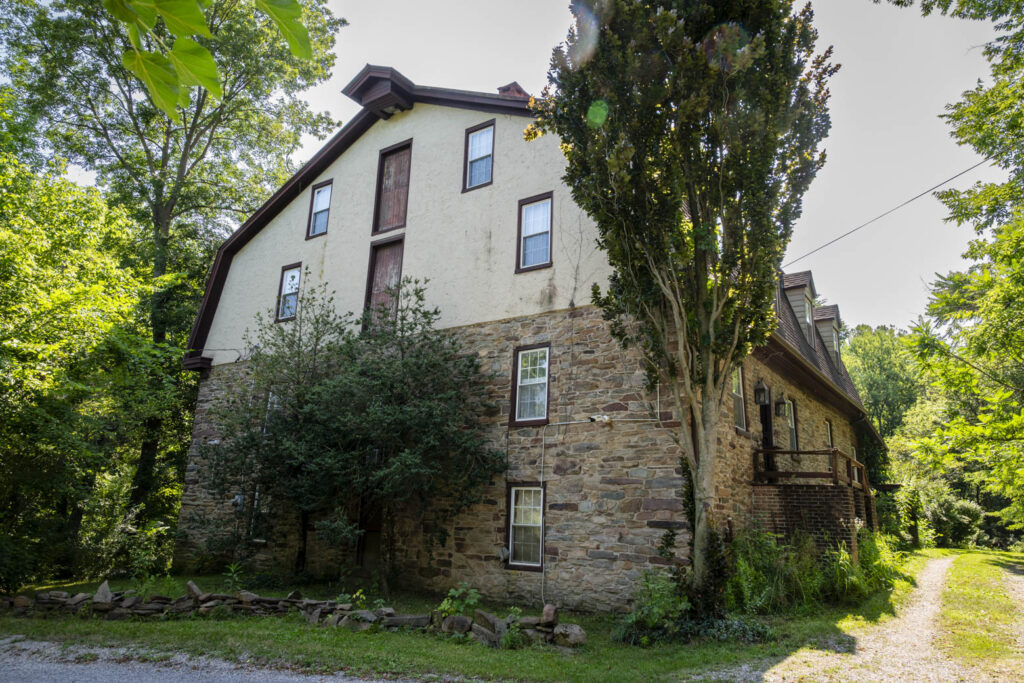
Grant Voaden wrote that Joseph Latshaw built this mill between 1755 and 1760 but there are no recorded deeds to back this up. Christian Close acquired 154 acres of land along the Big Conewago creek in what was then Reading Township in 1767. The heirs of Christian Close, which included son-in-law Peter Latshaw, sold the property with mills to Jacob Welsh in 1796.
The first mill utilized a wooden flutter wheel that measured six feet in diameter and was eight feet wide. Christian Close replaced the flutter wheel with a twenty-foot-diameter breast shot wheel. The water entered the buckets below the shaft. There was an attached sawmill that used a vertical-shaft water wheel called a “Krall Wheel” for power.
In 1824, Conrad Eisenhart came into possession of the mill. Again, there are no recorded deeds that document this transaction. Conrad’s son Peter took over the ownership in 1848. In 1883, Peter Eisenhart and his son Franklin upgraded the power with two thirty-six inch Bollinger turbines. Franklin acquired the property after his father’s death in 1894. Ownership transferred to Franklin’s son Elmer in 1920. Elmer was the last to operate the mill. Operations ended in 1965. Elmer Eisenhart also owned and operated another mill on the Conewago, further upstream in Adams County.
| Built | c1755 |
| Structure | 3.5-story Stone/Frame |
| Dimensions | 50 x 60 |
| Type | Flour, Grist, Saw, Cider |
| Power | Flutter, Breast, Turbine |
| Head | 7 feet |
| Disposition | Private Workshop |
| SPOOM | PA-067-044 |
| Water Source | Conewago Creek |
| Watershed | Conewago Creek |
| Township | Washington |
| Location | 39.948869, -76.960302 |